
COMPARE YOUR OPTIONS
Will or Trust? See the Difference Before You Decide.
Everyone has an estate plan. If you don't create one, your state's default plan applies. Here is a clear, side-by-side look at what happens with no plan, with a will, and with a properly funded living trust.
COMPARE YOUR OPTIONS
Will or Trust? See the Difference Before You Decide.
Everyone has an estate plan. If you don't create one, your state's default plan applies. Here is a clear, side-by-side look at what happens with no plan, with a will, and with a properly funded living trust.
ESTATE PLANNING EDUCATION & COORDINATION
Trust-Based Estate Planning for Families Who Want Clarity and Control
We come to you when signatures matter.
Fortis Planning helps families understand and coordinate trusts, wills, powers of attorney, and legacy planning: with a clear, educational process designed to protect the people and property that matter most.
Based in Oregon • Serving families in many states across the U.S.
START HERE
There Are Really Only Two Plans
Most people tell us they need a will, usually because that is what they have always been told. But very few can explain what actually happens to a will after someone passes away.
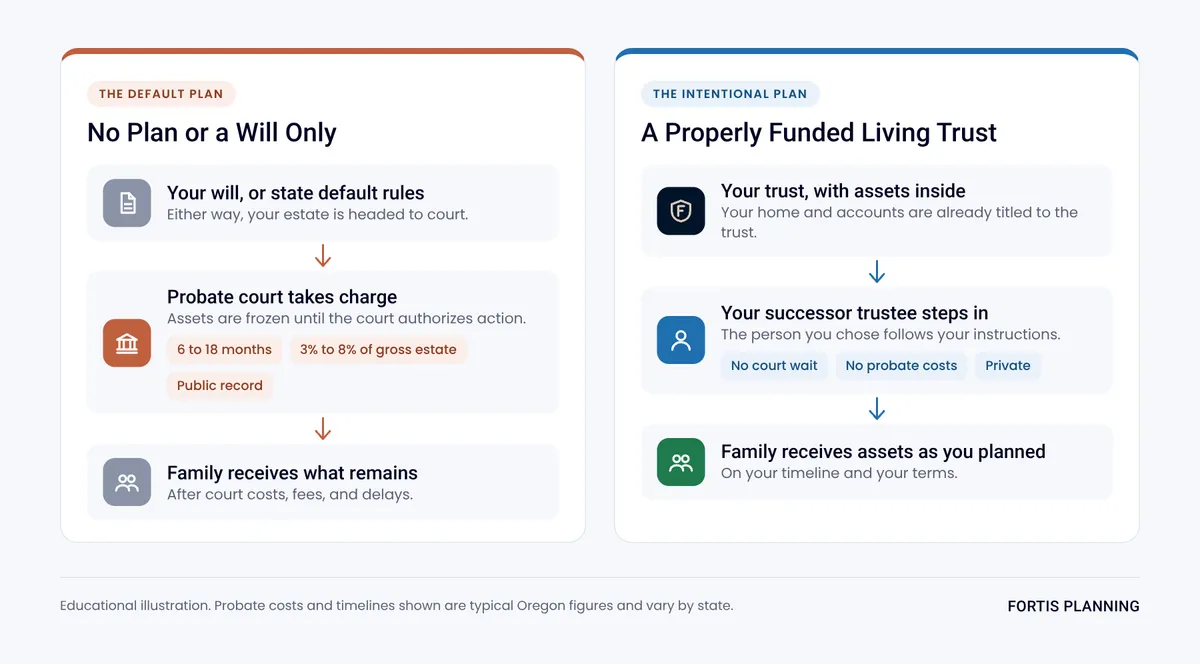
Here is the short answer: a will does not avoid probate. It is the set of instructions the court uses during probate. So whether you have a will or no plan at all, your family still ends up in the same court process.
That leaves two real choices. You can let the state's default plan decide, or you can create an intentional plan that keeps decisions with the people you trust.
Side by Side
How Your Options Compare
A quick look at how each approach typically works. Every family and every state is different, so think of this as a starting point for a conversation, not a final answer.
What the Comparison Shows
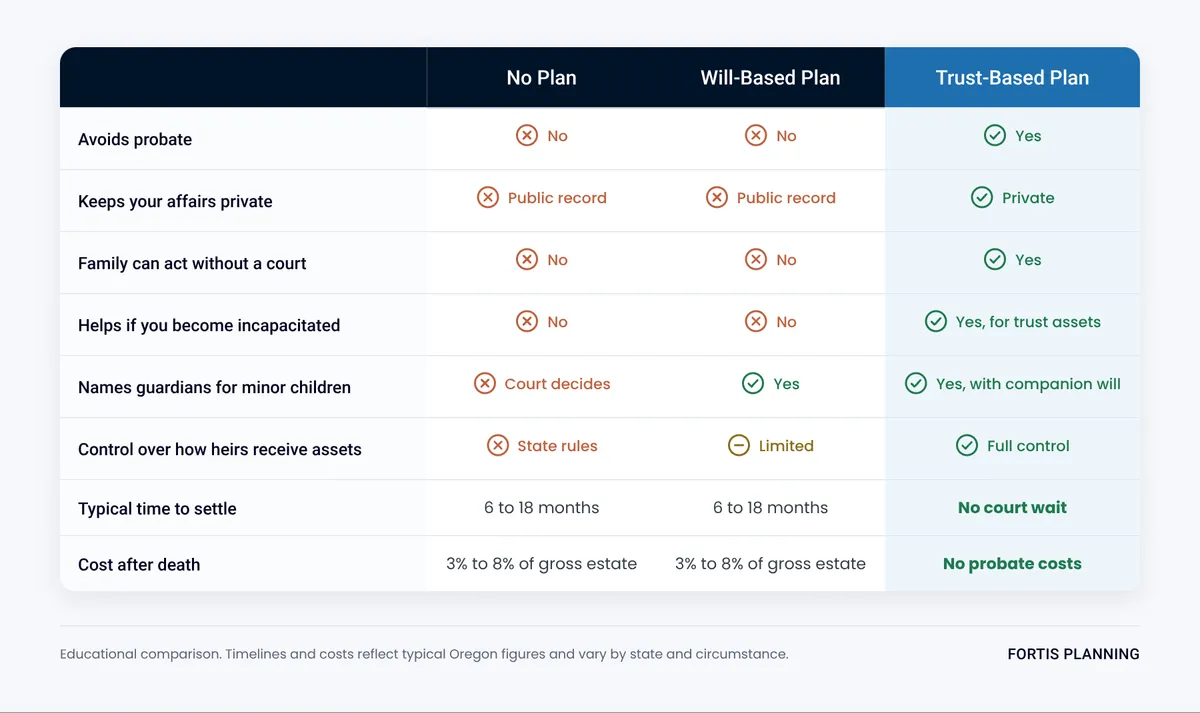
With no plan or a will, your estate goes through probate. In Oregon, that commonly takes 6 to 18 months, costs 3% to 8% of the gross estate, and becomes public record. A will can name guardians for minor children, but it does not help if you become incapacitated.
A properly funded trust-based plan avoids probate for trust assets, stays private, and lets your successor trustee act right away, including if you can't manage your own affairs. It also lets you control how and when heirs receive what you leave them.
*** Figures reflect typical Oregon examples and are for educational purposes only. Probate rules, costs, and timelines vary by state and by circumstance.
WHAT PROBATE CAN COST
A Real-World Oregon Example
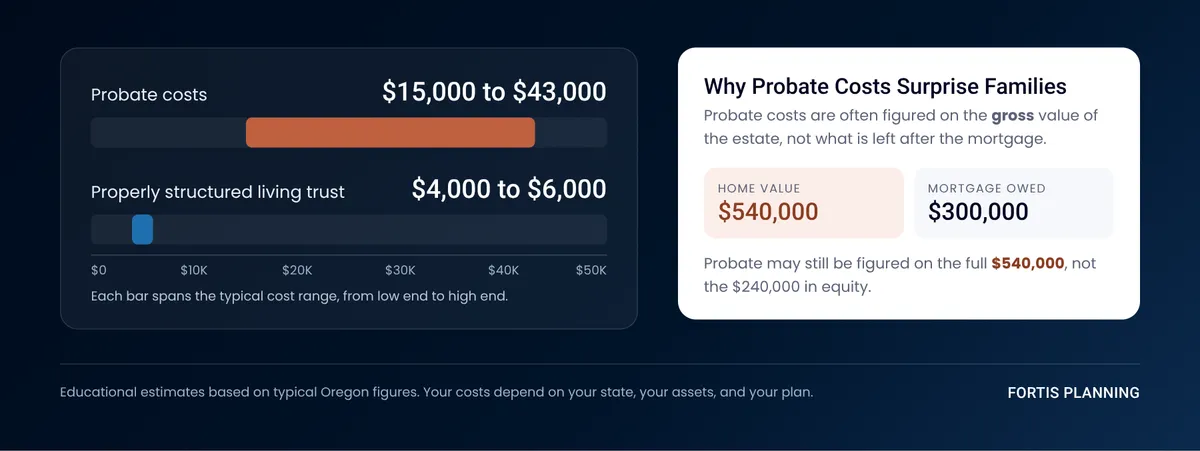
Probate costs are often figured on the gross value of the estate, not what is left after debts. That surprises a lot of families.
Say your home is worth $540,000 and you still owe $300,000 on the mortgage. Probate may still be figured on the full $540,000. On the average Oregon home alone, that can add up to $15,000 to $43,000.
A properly structured living trust typically costs $4,000 to $6,000. It costs more up front than a simple will, and often far less overall.
WHICH FITS YOUR FAMILY?
The Right Question Is What Fits, Not What Is "Better"
Some families are well served by a will-based plan. Others benefit from the privacy, continuity, and control a trust-based plan can provide. Here are a few signs pointing each way.
A Will-Based Plan May Fit If…
You do not own real estate
Your accounts already pass by beneficiary designation
Your main goal is naming guardians for young children
Your family is comfortable with a court process
A Trust-Based Plan May Fit If…
You own a home or other real estate, in any state
You want to spare your family the time, cost, and publicity of probate
You want someone you trust ready to step in if you cannot manage your affairs
You want control over when and how heirs receive assets
You have a blended family, a business, or a loved one with special needs
DON'T OVERLOOK THIS
What If You Can't Speak for Yourself?
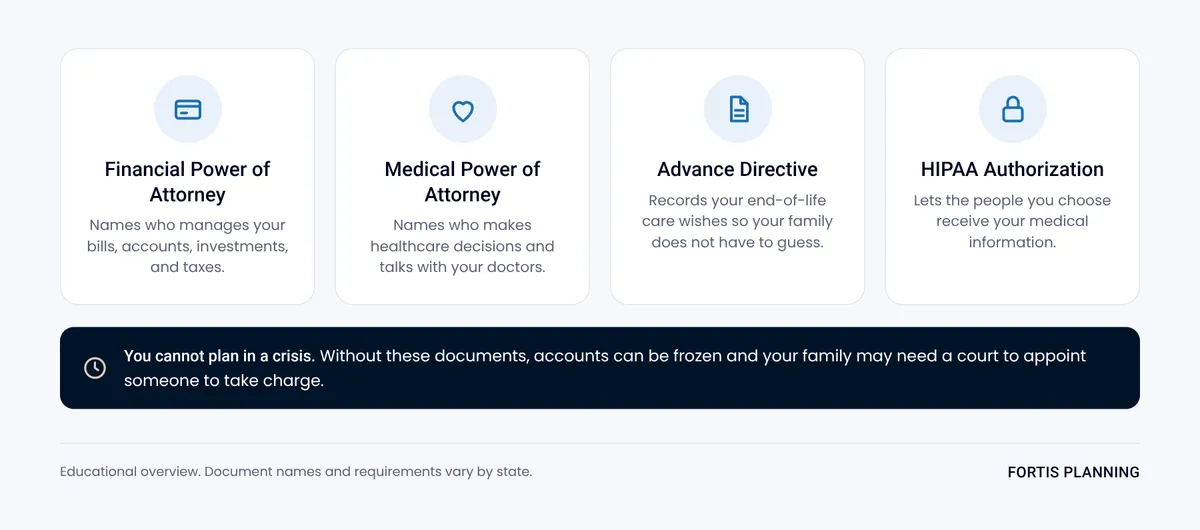
Estate planning is not only about what happens after you pass. An accident, a stroke, or a complication from surgery can leave you alive but unable to make decisions. A will does nothing here, because it only takes effect at death.
Without the right documents, bank accounts can be frozen, doctors may not be able to share information with your family, and your loved ones may have to ask a court to appoint someone to take charge. You cannot plan in a crisis.
Whichever direction you choose, every complete plan should include a financial power of attorney, a medical power of attorney, an advance directive, and a HIPAA authorization, all signed before you need them.
COMMON MISUNDERSTANDINGS
What We Hear Most Often
"I have a will, so I'm covered."
A will is a good start, and it can name guardians and express your wishes. But it does not avoid probate, and it does not help if you become incapacitated.
"Trusts are only for wealthy people."
If you own a home, you likely have an estate that could benefit. Probate costs are figured on gross value, so even a modest home can make probate expensive.
"I'll get to it later."
Most people delay because they are busy, assume it costs too much, or do not know where to start. Unfortunately, life does not wait for a convenient time.
QUESTIONS
Will vs. Trust FAQs
Does having a will keep my family out of probate?
The question is not whether a will or trust is “better.”
How long does probate take?
In Oregon, probate commonly takes 6 to 18 months, and sometimes longer. During that time, assets may be frozen until the court authorizes action.
Is a living trust more expensive than a will?
A trust usually costs more up front. Because it can help your family avoid probate costs that are often 3% to 8% of the gross estate, it frequently costs far less overall.
Do I still need a will if I have a trust?
Yes. A trust-based plan typically includes a companion will that catches anything left outside the trust and names guardians for minor children, along with powers of attorney and healthcare documents.
What happens if I die without any plan?
Your estate goes through probate, and the court distributes your assets according to your state's default rules, which may not match what you would have wanted.
Getting Started
YOUR NEXT STEP
You don’t need to have everything figured out before we talk. Share what you want to protect, the questions you have about your planning options, or the decisions you’re trying to make. We’ll listen and help you identify a clear next step.

Estate planning education and coordination to help families protect what matters most.
By Appointment Only
CONTACT
Hours:
8:00 a.m. to 5 p.m. PST
Monday through Saturday
By appointment only
After-hours by request
Oregon Address
7307 SW Beveland St Ste 200 Tigard, OR 97223



Fortis Planning, LLC provides estate planning education and coordination. We are not a law firm and do not provide legal, tax, accounting, or investment advice. Legal documents are prepared and reviewed by licensed attorneys in the applicable state. Consult qualified professionals about your individual circumstances.
Copyright: © 2026 Fortis Planning, LLC. All rights reserved.